
































Communications Professor to Deliver Lindberg Lecture May 8
By Lori Wright, Media Relations
May 7, 2008

Sheila McNamee, professor of communication, will deliver the Lindberg Lecture
Thursday, May 8. The highest award of the College of Liberal Arts, it is given
annually to an outstanding teacher and scholar in the college.
The 2007 Lindberg Award winner, McNamee’s lecture, “Transformative
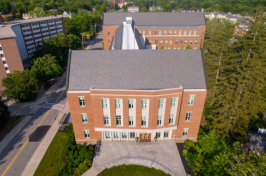
Dialogue: Coordinating Conflicting Moralities,” begins at 1 p.m. in 115
Murkland Hall. The lecture is free and open to the public.
“Her current and former students write passionately about the influence
she has had on their lives. And her colleagues see her as a model to emulate
in teaching, research, and contributions to the many communities she serves.
The Lindberg is a fitting award for the cumulative success she has achieved,” said
Marilyn Hoskin, dean of the College of Liberal Arts.
First appointed in 1982 from the doctoral program at the University of Massachusetts,
McNamee has become one of the university’s most engaged faculty members
across all areas of involvement. Under her leadership the department of communication
developed an impressive core of faculty achievement and innovative curricula
for students.
Over the course of her career at UNH McNamee, who studies interpersonal communication,
has produced five books and 50 journal articles and book chapters, all while
presenting colloquia or workshops in more than 45 international settings. Her
work on the intersection of language and social construction has attracted
broad acclaim and spawned a range of related work on personal interaction.
In keeping with tradition, the Lindberg Award celebration will include the
announcement of the 2008 winner, who is Scott Schnepf, professor of studio
art. Schnepf has taught at UNH since 1981, and served as department chair for
two terms. He has permanent collections in a number of museums, including the
Portland (Maine) Museum of Art, Currier Gallery of Art, and The Library of
Congress.
“Professor Schnepf has a record of achievement as a teacher and scholar
that is approaching three decades long, and his work in the classroom and studio
has always inspired the respect and admiration of his colleagues, his students,
and art lovers all over New England,” said Craig Hood, professor of studio
art.
While agreeing with Hood regarding Schnepf’s dedication to and support
of his students and colleagues, Mara Witzling, professor of art and art history,
said Schnepf’s greatest distinction is his body of work.
“Scott’s etchings glow -– they vibrate with an internal
light. He imbues ordinary things – a glass, a bowl, a plant, a beetle
-- with a sacred quality,” Witzling said. “His art is about quiet
things, the heroic in the every day, and similarly, over the years he has kept
at his art without making a big splash on the art scene, but persisting, nonetheless,
in making works of extremely high caliber.”
Former student Brian Elder said Schnepf had a profound impact on him. Now
an assistant professor of art at Central Michigan University, Elder said he
still looks to how Schnepf mentored him as a guide for his interactions with
his students.
“My aim, building from my own experiences in Scott Schnepf’s classes,
is to provide a firm foundation to learn the language that will propel my students
toward the work that they must do. I can work toward this because of what was
given to me in quiet conversations, back in Durham,” he said.