






























Improved Social Skills Programming Needed for Students with Autism
By Matthew Gianino, Institute On Disability / UCED
March 12, 2008
In response to the growing need for more effective social skills programming
for students with autism spectrum disorders (ASD), the Institute on Disability
at UNH will present “Building Social Relationships and Use of Video Modeling” on
Friday, April 11, at the Derryfield Country Club in Manchester.
This workshop, taught by Dr. Scott Bellini, is the third and final installment
of the 2007-2008 Research to Practice Series on Autism Spectrum Disorders.
It is widely known that individuals with ASD often have difficulty establishing
and sustaining meaningful social relationships with others, and for many students
with ASD, school-based social skills programming is prescribed to encourage
social, emotional, and cognitive development. According to research conducted
by Bellini and the Indiana Resource Center on Autism, however, few students
are actually receiving the programming they need and would benefit from most.
In the wake of conducting a large-scale meta-analysis on school-based social
skill interventions for students on the autism spectrum, Bellini argues that
children with ASD are in desperate need of more effective social skill programming.
Results of the study revealed several problems with current social skills
programming practices. First, the research suggests the amount of time spent
on social skills interventions (typically 30 hours over 10-12 weeks) is insufficient.
Second, interventions often take place outside of the general education classroom
in “pull-out” settings, frequently discouraging the social connection
that the programming is meant to support.
Third, students’ social skills are not being assessed correctly, resulting
in programming which does not fit students’ individual needs. Finally,
because of a lack of resources or a tendency to only use the strategies with
which they are most comfortable, educators may not be implementing interventions
properly, inadvertently forcing students to “fit” into chosen social
skills strategies.
Since a lack of social skills may potentially lead to academic, behavioral,
and emotional difficulties, Bellini argues in a recent article that educators “must
look for opportunities to teach and reinforce social skills as frequently as
possible throughout the school day, and not just in pull-out settings…Teachers
and other school personnel should [also] place a premium on selecting social
skill interventions that can be reasonably implemented within multiple naturalistic
settings. This is particularly important for children with ASD, who may have
considerable difficulties transferring skills from one setting to another.”
During the morning session of the two-part workshop, Bellini will briefly
highlight his most recent research on the effectiveness of school-based social
skills interventions before providing an overview of a social skill instructional
model which he developed.
The five-step model provides parents and practitioners with a systematic and
comprehensive framework to guide the development and implementation of social
skills programming in the general education classroom.
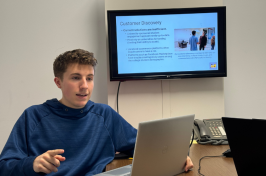
During the afternoon, Bellini will discuss his research on video modeling,
one social skills intervention technique which has shown positive results when
implemented properly for appropriate students in the right settings.
Video modeling is a teaching method that involves having children watch a
pre-recorded video of a task or behavior, and then having them copy what they
have seen. This technique of using videotaped rather than “live” scenarios
for children to observe helps to focus their attention and create a highly
effective stimulus for learning.
Bellini is the assistant director of the Indiana Resource Center for Autism
at Indiana University, Bloomington (IUB), and an assistant professor with the
IUB School Psychology program. In addition to his work at the university, Bellini
operates a therapeutic clinic specializing in social skills programming for
children and adolescents on the autism spectrum.
He has published numerous articles and spoken nationally on the topic of social-emotional
functioning and programming for children with ASD. He is also the author of
the book “Building Social Relationships,” which was named the 2007
Literary Work of the Year by the Autism Society of America.
The program is from 9 a.m. to 3 p.m. Registration is $125 and includes workshop
materials, continental breakfast, and lunch. For more information and to register
go to http://iod.unh.edu/events.html#rtp3 or call 2-2084