


















UNH Receives $380,000 Grant to Study Organic Dairy as Closed Ecosystem
By Beth Potier, Media Relations
June 11, 2008

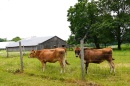
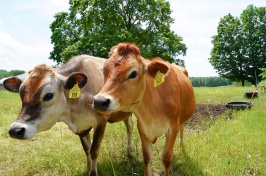
Jersey heifers at the UNH Organic Dairy Research Farm, where researchers are exploring whether the farm can become a completely self-sustaining facility.
UNH researchers have received a significant grant to study UNH’s organic
dairy research farm as a sustainable closed agroecosystem, exploring viable
strategies for becoming energy independent. The $380,000 three-year grant,
from the U.S. Department of Agriculture’s Sustainable Agricultural Research
and Education (SARE) program, aims to explore whether closing energy and nutrient
cycles could help small family dairy farms in the Northeast survive economic
vulnerabilities.
The study comes as rising energy, feed and capital investment costs shrink
the already narrow profit margin of dairy agriculture in the Northeast, threatening
the regional sustainability of the industry. “In a closed system, the
only thing leaving the farm is the milk,” says John Aber, professor of
natural resources at UNH and the principal investigator on the grant. “The
goal is to see whether we can have a closed-nutrient-cycle and energy-independent
organic dairy.”
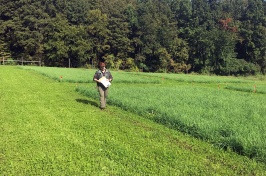
In a closed system, for instance, cow manure fertilizes the fields on which
the herd grazes. Sawdust from woodlands on UNH’s 300-acre farm in Lee
might be utilized for animal bedding, which is becoming increasingly expensive;
woodlands might also provide fuel for small cogeneration plants. Methane digestion
could produce usable methane from manure.
The first step for Aber, his faculty co-investigators, and UNH students who
are working on the project is to assess energy and nitrogen budgets and balances.
Nitrogen, he says, is the nutrient more critical to plant growth in the Northeast
than any other; it comes from rainfall but can also be replaced by legumes
like soybeans or clover. “If you want to maximize dairy production and
dairy output, you need to replace the nitrogen leaving the farm in milk,” he
adds. In the second and third years of the grant, the researchers will look
at alternative ways to close the energy and nutrient cycles.
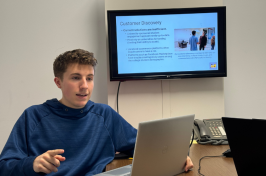
This past spring, five UNH undergraduates and a graduate student worked with
Aber to study nitrogen flows and energy inputs and outputs. Results of those
studies suggested that both energy independence and a closed nitrogen system
could be achieved through intensive management of manure; changing the bedding
method of the farm’s 40 cows; increasing the cows’ time on pasture;
and growing grain, hay bedding and silage on-site instead of purchasing them
from external sources.
This research will point UNH – and, Aber and his collaborators hope,
organic dairy farmers from around the Northeast – toward alternative
farm management practices that could lead to more stable economic outcomes
for small family farms. “We’re moving toward a sustainable, closed
system,” says Aber, “and toward best-practices to achieve that
goal.”

Such an ecosystem-level approach to a commercial organic dairy production
is unique, at least in the United States, where UNH’s organic dairy farm
is the first commercial-scale research organic dairy. Aber and co-investigator
William McDowell, also a professor of natural resources, bring to the project
forest ecosystem experience as investigators on the National Science Foundation’s
Long-Term Ecological Research (LTER) program.
Other co-investigators are associate professor of hydrogeology Matt Davis,
Charles Schwab, professor of animal and nutritional sciences and a leader in
the founding of the organic dairy, and organic dairy project director Kevin
Brussell. “The synergy of ecosystems expertise and dairy expertise is
far greater than the sum of its parts,” says Aber.
“Family dairy farms are a vital part of the landscape and legacy of
the Northeastern United States,” says UNH chief sustainability officer
Tom Kelly, who conceived of this project. “This research will help small
farmers in this region make informed decisions in the face of an uncertain
energy and economic future and contribute to a more resilient food system.”
For more information on UNH’s Organic Dairy Research Farm, go to www.organicdairy.unh.edu.