Making Music From Scratch
By Jody Record, Campus Journal Editor
July 23, 2008

Every summer for the past 35 years, Karl Roy has traveled to New Hampshire
to share a passion born in the Alps of his German homeland and bred at UNH’s
Violin Craftsmanship Institute.
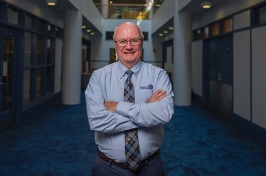
Roy makes violins. Since 1973, he has come to Durham to teach the skills he
learned at the Bavarian State School for Violin Making in Mittenwald where,
for 20 years, he was an instructor and then director.
He is joined at the institute by fellow Mittenwald native Horst Kloss, who
specializes in violin repair and restoration; Lynn Armour Hannings, who teaches
bowmaking techniques and repairs; and George Rubino, the bowmaking instructor.
Roy is retiring this year.

Master craftsman Karl Roy inspects a student's work.
The five-week institute draws people from all walks of life: a dentist, a
professional violinist and a surgeon have all been students. Attendees--beginners
to career musicians are welcome--can sign up for one workshop or all five.
The workshops run from 8 a.m. to 9 o’clock at night with an hour for
lunch and two hours for dinner.
This summer marks Jan Wahl’s fourth year of coming to the institute.
A dentist from Melbourne, Fla., Wahl says it will take her another year, still,
to finish the violin she began in 2004. She has played the violin since she
was a young girl. The decision to make her own instrument came from a sense
of need.
“There’s a feeling you have—that you have to do something
more than play,” Wahl says.
And for Jim Robinson, Roy’s shop foreman for six years, that has meant
taking his interest in violins to a higher level. Since coming to the institute
as a student in 1999, Robinson has made 30 violins, six cellos and four violas.
And he has sold them all.
When he started, the Violin Institute was held for seven weeks. Robinson attended
all seven weeks for four years.
“As a new person, you don’t see much progress in a week,” Robinson
says. “I wanted progress.”
Zoran Stilin of Arizona has been studying under Roy for 12 years. A professional
cellist with the Tucson Orchestra, he has made cellos and violins.
“I’m still learning. I come back because there is so much to learn,” Stilin
says.
“We’re all always learning,” says Roy, a master craftsman.
To earn that designation, one starts as an apprentice, moves on to journeyman
and then works as an assistant for five years before being eligible to apply
to be a master.
“In Europe, the title of master is protected. You can’t open your
own shop, you can’t teach, until you are a master,” Roy says.
A Roy violin sells for 18,000 to 20,000 Euro or $30,000 U.S. dollars. It takes
about 130 hours to make.

A student in the Violin Craftsmanship Institute. measures the bottom of the
violin she is making.
George Rubino can teach a student to make a bow in about two weeks. It takes
a week alone for the stick; three or four days for the frog, and the button,
another few days. Every one is different, Rubino says.
“It’s a very individual thing,” Rubino says. “It depends
on how long the bow stays on the strings. The more cooperative the bow, the
better it will sound. It’s a marriage of the player, the instrument and
the bow.”
Rubino plays bass with the Portland, Maine, Symphony. His first summer at
the institute was in 1981. He owns a bow shop in Pownal, Maine, and earns his
living as a professional bow maker.
“My bows go all over the world,” he says. “I just sent one
to New Zealand. I have a lot in major orchestras. It’s great fun.”

Horst Kloss, master violin maker, works on a scroll.
Kloss owns the oldest professional violin shop in Boston. Business is so good
he has to turn down almost 90 percent of the customers who seek him out. Yet
he relishes the time he spend at the Violin Craftsmanship Institute.
“The thing that’s unique about UNH is you don’t have to
pass an exam to come,” Kloss says of students. “You just have to
have interest and motivation. Some have never held a tool in their hand before.”
Kloss, who also grew up in Mittenwald, began playing the violin when he was
13.
“On the way to school I’d pass the violin shops and the old violin
makers would invite me in so I’d go,” he says. “I was on
very fertile ground. I fell in love with the violin and I’m still in
love.”
The Violin Craftsmanship Institute is sponsored by UNH Professional Development
and Training. For more information go to https://www.learn.unh.edu/forms/vregnow.html.