






























Professor Wins Grammy Award
By Matthew Gianino, Institute on Disability / UCED
February 13, 2008
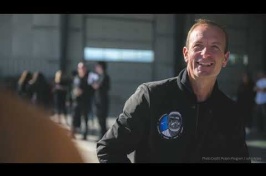
Kevin Short, professor of mathematics at UNH, won a Grammy award Feb. 10 for
his role in restoring an antique recording of a Woody Guthrie concert. Here
he holds the cover for the CD and book, “The Live Wire: Woody Guthrie
in Performance 1949,” and the medallion he received as a Grammy award
nominee. Photo: Douglas Prince ,Photo Services
Kevin Short, UNH professor of mathematics, won a Grammy Award Sunday night
for his role as a mastering engineer in the restoration of a 1949 wire recording
of a live Woody Guthrie concert. Short and his wife, Michelle, attended the
star-studded award ceremony in Los Angeles Feb. 10.
Short was part of a team honored by The Recording Academy for their work to
produce “The Live Wire: Woody Guthrie in Performance 1949.” One
of five nominees for best historical album, it is the only known recording
of Guthrie performing in concert before an audience.
The team included Woody Guthrie’s daughter, Nora, president of the Woody
Guthrie Archives; Jorge Arevalo Mateus, archives curator; Steve Rosenthal and
Warren Russell-Smith of The Magic Shop, a recording studio in New York City,
and Jamie Howarth, music restoration specialist and founder of Plangent Processes.
The historical category award was presented in the “pre-telecast” ceremony
in the afternoon before the televised event. When the award for best historical
album was announced, Short admitted, he sat frozen for a split second until
he saw the other members of the Guthrie team on their feet.
“Climbing onto the stage and standing in the glare of the lights as
the trophy was awarded seemed almost other-worldly,” he said.
This couple with four children from a small college town found themselves
immersed in the glitz and glamour of the music industry.
“We were seated in the ring right around the super-celebs, most of whom
had a bit of an entourage around them. During commercial breaks, there was
a flood of people in and out around these celebrities,” he said. “We
were 60 to 100 feet from the performers, and we watched Beyoncé rush
in right in front of us as she raced to her seat after performing on stage.”
The events, of course, were black-tie.
“I felt like I tried on every dress in New Hampshire and nothing was
right.” Michelle Short said.
Finally, she found a floor-length pewter-colored gown at a Macy’s store
in Massachusetts. Short wore a vintage dinner jacket that he has had since
his days as a graduate student at the Imperial College in London.
It was a quick trip. They booked a room at a small inn in Venice Beach and
caught the red-eye flight after the show. Although their visit was limited,
they encountered a number of people who were aware of the Guthrie project.
“Everyone that we spoke to that weekend had heard about it,” said
Short.
Guthrie was a folksinger who crusaded against poverty and social injustice
in the years following the Great Depression, writing many songs that are still
familiar today. Every school child knows “This Land is Your Land,” and “I’m
Shipping up to Boston” became the anthem of the Boston Red Sox when they
won the 2007 World Series.
In 2001, the Woody Guthrie Archives in New York City received a package containing
two spools of wire which had been recorded in 1949 at a Guthrie concert in
New Jersey by a college student, Paul Braverman. The team of sound restoration
experts was assembled to transfer the recording from the brittle 50-year-old
wire to a digital format.
Short is known for his discovery of chaotic compression technology, which
uses advanced signal processing methods and a mathematical theory known as
chaos in the analysis of audio, speech, video and image data. When you download
a song or an artist’s ring tone to your cell phone, you are using this
type of technology.
In the Guthrie restoration project, Short applied some of the mathematics
of compression techniques to interpret the highly irregular and broken signal
from the wire recording.
“I came in at the end of the project,” said Short. “The
painstaking work of transferring the sound from brittle wire to a digital signal
had already been done. By fine-tuning the Plangent Processes algorithms, we
were able to remove the speed and timing problems in the signal. At first,
there were segments where we could barely understand the songs or the dialog
that had been recorded, but afterward the tracks had stabilized pitch and clarity.
The engineers at The Magic Shop then worked their magic on the tracks to reduce
the noise and bring out Woody’s voice. The result was a sound of remarkable
quality for a recording of that era.”
The mathematics of signal processing has led Short down some interesting paths:
downloads for cell phones, restoration of antique music recordings. What’s
next? His current projects may lead to the development of better hearing aids
for the deaf, and more sensitive detectors for explosive materials used in
making bombs.
“As you can imagine, folks around campus are pretty excited to see one
of our own recognized as professor Short has been in receiving a Grammy Award,” said
professor Joseph Klewicki, dean of CEPS. “Kevin is an example of great
minds here at UNH doing great things.”
More information about “The Live Wire: Woody Guthrie in Performance
1949” and information on how to order the CD can be found on the Woody
Guthrie Archives website, www.woodyguthrie.org.