DeMeritt Hall, Home of the Physics Department, Ready For Students
By Jody Record, Campus Journal Editor
August 6, 2008

Perry Smith photo
The new DeMeritt Hall isn’t much bigger than the one built in 1913 with
money secured by its namesake Albert DeMeritt, but differences between the
two buildings are huge.
“It’s about quality of space,” says Doug Bencks, university
architect and director of Campus Planning. “The building is designed
to give us what we need for the next 100 years.”
Workers began moving furniture into the building this week.
Built without a basement because of the amount of ledge on the lot, the new
physics building has about 53,000 square feet. The three floors are made up
of classrooms, laboratories, a library and two lecture halls.
The larger of the two lecture halls, on the ground floor across from the library,
seats 180 while the other has seating for 80. Fans are built into the steps
to provide constant air flow.

Fans built into the steps in the lecture halls provide constant air flow.
The library has one of the three pieces of public art that will be on display
in the new building. All are related to physics.
Other rooms include a standard classroom, two studio classrooms, four physics
teaching labs and two meeting rooms, one for students and the other for faculty
and staff.
Studio classrooms have computers on round tables so students can work collectively.
The rooms also have video projectors on opposite walls so an image can be seen
regardless of where one sits.

One of the research labs in the new DeMeritt Hall.
But that’s just the basic building information. Here are the real differences:
Outside some of the rooms there are black screens on the wall near the door.
If a laser is in use in the classroom, it will be noted on the screen.

Black screens outside the classrooms will indicate if a laser is on inside.
Most of the windows open, allowing for natural air flow and reducing energy
use. On the south and east sides of the building, the windows have fins to
optimize solar power. Additionally, the building was sited to take advantage
of the southerly daylight. A system known as an energy wheel captures the energy
that would otherwise be ventilated and uses it to temper fresh air.
The heating and air conditioning systems are designed to shut off if a window
is opened. The AC can also be operated independently. Lights dim automatically
depending on how bright it its outside.
Carbon dioxide sensors reduce ventilation depending on the number of people
in a room. And water will be conserved in the bathrooms with waterless urinals
and sensor-controlled sinks.
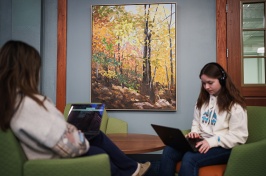
There are two open lounge spaces where students can study. The hardwood floors
in these areas were recycled from the original DeMeritt. About 98 percent of
debris was recycled when the building was demolished. The blackboard in the
third floor lounge is also from the old building.
On budget at $20.5 million, the project was funded primarily through money
approved by the state Legislature in 2001 to help finance a number of projects
across the university system. In 1911, Albert DeMeritt approached the Legislature
seeking $80,000 to build UNH’s first physics department. The measure
was vetoed but two years later, shortly before his death, funding was approved.
DeMeritt died in August 1913. DeMeritt Hall was dedicated on December 16.