

























Horticultural Tech Students Create Sustainable Landscape
By Beth Potier, Media Relations
April 30, 2008

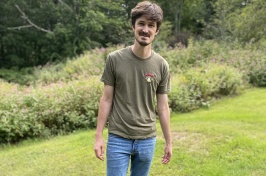
L - R: Thompson School students Douglas Maloy, Denison Church, Kendra Hamel and
Julia Palatine discuss the sustainable landscaping in front of Putnam Hall. Credit:
Perry Smith/UNH Photographic Services. Perry Smith photos.
Students in a horticultural technology class at the Thompson School for Applied
Science have completed a final project that will live on long after grade books
are closed and the students themselves have graduated.
Putting the “earth” into Earth Day, students in associate professor
Dana Sansom’s grounds management course installed sustainable landscaping
around the university’s Putnam Hall this week. In addition to providing
low-maintenance yearround beauty, the landscaping will be a living classroom
for future horticulture students and anyone interested in sustainable landscaping.
“We specifically chose plants not very common on campus, so the garden
can be used as a teaching tool,” said Thompson School student Henry Hess.
“And you can appreciate its beauty instead of having to prune,” said
Thompson School student Jim Lynn, who designed the landscape with Hess and
student Katie Leipold. All 11 students in the class worked on the plan and
studied sustainable landscaping for the past year.
For the past month, students in the course have been preparing the site – largely
neglected for the past decade -- for the new design, removing overgrown plants,
testing and preparing the soil with compost (UDoo, a product of food waste
from UNH dining halls) and other amendments. They removed thick patches of
aggressive pachysandra and several overgrown yews that were blocking light
from entering the building.
Applying the principles of sustainable landscaping, the students focused on “right
plant, right place,” choosing plants that would be hardy in New Hampshire
and siting them in as much sun or shade as they need to thrive. Not all plants
are native – “There’s some debate in sustainability as to
whether plants have to be native to be sustainable,” said Lynn – but
none are invasive.

Thompson School associate professor Dana Sansom and grounds management student Katie Liepold of Wolfeboro Falls discuss the sustainable landscape Liepold helped design.
“They all live in harmony with native plants,” Hess added. Plants
were selected for their ability to attract wildlife by providing food or habitat;
wildlife in turn sustains the landscape by providing pollination and returning
organic matter to the soil.
Most of the garden’s visitors will be drawn to its beauty, and the students
designed the garden with an eye toward yearround interest; a balance of colors,
textures and sizes; and the inevitable (and desired) growth and maturity of
each plant. The design uses no annuals, favored for their showy bursts of color
but which must be planted each season then discarded in the fall. “If
you plant your perennials and shrubs correctly, you can have blooms and yearround
interest,” said Hess, pointing out the bell-shaped flowers of Solomon’s
Seal, the golden spikes of rocket ligularia, the evergreen and red-berried
holly bushes, and the andromeda Brower’s Beauty.
Making the experience as real-world as possible, the grounds management students
also managed a “staff” of volunteers and worked with vendors, soliciting
donations from Millican Nurseries in Chichester, Stonepost Nursery in Raymond,
and The Mixed Border in Hollis. “We had a great response from the landscape
industry,” said Sansom, their professor.
While both Hess, a Concord, Mass., native, and Lynn, a Bostonian who now lives
in Epping, plan to pursue a bachelor’s degree after they receive the
Thompson School’s associate’s degree in May, they praise this capstone
project for giving them a solid grounding in the field of landscaping and horticulture. “This
has totally prepared us to have our own businesses when we leave instead of
working for someone else,” said Lynn.
Do they fear that the growing interest in sustainable, lower maintenance landscaping
will jeopardize their future careers? Not at all. Plenty of landscaping is
unsustainable and in need of professional services, they said. “And there’s
plenty of earth to be rejuvenated,” said Hess.
For more information on horticultural technology at the Thompson School for
Applied Science, go to http://www.tsas.unh.edu/ht/index.html.