































Researcher Is Mapping The Flow Of Communication
By Rebecca Zeiber, NH Sea Grant
April 23, 2008

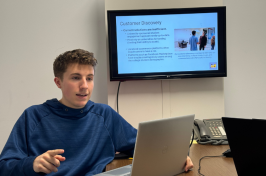
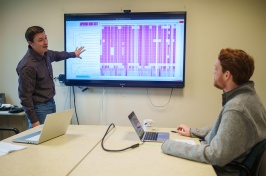
Troy Hartley shows a computer-generated "map" of communication networks for coastal and ocean management organizations. Photo by Rebecca Zeiber.
Troy Hartley could be considered a cartographer of human communication.
Hartley, a UNH research assistant professor in the department of resource
economics and development, is studying the patterns of communication within
and between various local and regional organizations.
Funded in part by NH Sea Grant, his project was motivated by the U.S. Commission
on Ocean Policy report that indicated effective coastal and ocean management
is inhibited by a lack of communication, coordination and a sense of partnership.
Specifically, Hartley is looking at the communication networks for projects
undertaken by the Atlantic Marine Fisheries Commission, the New England Fisheries
Management Council, the NH Coastal Program and the Cape Breton Island in Nova
Scotia.
Hartley used interviews and surveys to measure communication patterns among
individuals within these entities and projects. The frequency and directional
flow of information within and between the key individuals, such as project
coordinators, scientists and decision-makers, were then “mapped” using
the computer program Inflow.
The outcome depicts a spider web effect of points connected by lines in a
network. The points represent the individuals and the lines represent information
flow on daily, weekly or monthly time scales.
“Communication ‘maps’ make sense to people,” Hartley
explains. “They create a visual of something that is conceptually difficult
to wrap your arms around.”
“Social scientists have studied regional government in other contexts,
such as public transportation, water and wastewater management,” Hartley
adds. “But we will struggle finding the best ways that people can work
together, communicate and coordinate effectively on a regional scale. We need
to get better at that for regional integrated coastal and ocean management
to become a reality.”
As his research has progressed, Hartley has noticed some trends emerging that
highlight some differences in communication networks and also some of the challenges
involved.
The maps depicting the channels of communication among individuals in a watershed
planning organization show relatively tight communities among participants
who know of each other well and interact frequently. For example, the watershed
planners might have planners, ecologists, GIS experts and government managers
all interacting on a regular basis. The maps show lots of lines crisscrossing
and forming a tight cluster of communication with many individuals talking
with each other — something called the “density” measure
of a network.
On the other hand, Hartley shows a communication network map involving herring
management, a large regional fisheries case. There were more than 150 individuals
from industry, government, conservation groups, scientists and other stakeholder
groups involved weekly at various levels. However, the lines depicting the
flow of communication show dense clusters of activity with fewer lines connecting
the clusters to one another than was observed in the watershed planning case.
“Participants involved with herring management have very specialized
roles and interests,” Hartley explains. “A lot of the network weight
falls on certain individuals to keep the communication flowing. Some individuals
bear the brunt of the burden for ensuring information flows across the diverse
groups. The network is vulnerable to their status and availability. For example,
are they on vacation? Are they temporarily pulled away by another project?
Do they always have the support necessary to serve this role?”
Hartley says the results of the research will encourage strategic thinking
about network design and recommend changes in the function of the network and
roles of individuals. Upon looking at these maps, some individuals have noticed
that their information flows to other participants in unexpected ways, based
upon the frequency of communication among others in the network.
In addition, the maps identify the key individuals who are in touch with various
stakeholders and groups. These individuals can then be targeted by those needing
to broadcast information to the rest of the group.
“Our communication effectiveness and influence are not independent of
the other individuals in our own networks,” Hartley says. “It is
more than ‘who you know’ that is important, it is ‘who do
the people you know know.’”
“I enjoy seeing what the maps can do for people to improve communication
within and among regional government entities,” Hartley adds. “We
can work in a coordinated way and the maps give us the guidance to get there.”