






































UNH Scientists Aloft as Part of Major NASA Airborne Arctic Study
By David Sims, Institute for the Study of Earth, Oceans, and Space
April 2, 2008

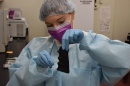
Eric Scheuer of UNH installs the Soluble Acidic Gases and Aerosol instrument in NASA's DC-8 for the ARCTAS mission
Today marks the start of NASA's most extensive field campaign ever to probe
the chemistry of the Arctic's lower atmosphere. The investigation is poised
to help scientists identify how Earth's atmosphere contributes to the recent,
dramatic changes in the vast, climate-sensitive region.
The first phase of the two-part, international campaign known as the Arctic
Research of the Composition of the Troposphere from Aircraft and Satellites
(ARCTAS) was launched to coincide with the Sun's annual return north where,
after months of darkness, it begins -cooking- the snow and ice, oceans and
atmosphere, and driving important physical and chemical processes.
Among the 30 teams of investigators aboard three research aircraft that will
fly during the field campaign are atmospheric scientists from the University
of New Hampshire, who are on board the space agency's instrument-laden DC-8
-flying laboratory- that today began making a spate of atmospheric measurements.
The airborne sampling, and subsequent data analysis, will reveal how gases
and small particles in large air masses transported around the globe are affecting
changes on the ground in the Arctic.
“We're going to fly into these plumes of air to see where they're coming
from, where they're going, and what they're composed of,” says UNH scientist
Jack Dibb of the Institute for the Study of Earth, Oceans, and Space (EOS).
From the DC-8, Dibb and UNH colleague Eric Scheuer will be sampling gaseous
nitric acid - a byproduct of pollutants emitted by car and truck engines, particles
in the atmospheric known as aerosols, and mercury - a ubiquitous toxin that
is very tricky to measure.
The airplane-based sampling will aid in the interpretation of complex satellite
measurements taken over the Arctic and improve global chemistry and climate
models. This will ultimately provide scientists with a better idea of how pollutants
are transported to and around the Arctic, and what their impact on the environment
and on the climate might be.
The Arctic is a beacon of global climate change. It is where warming has been
strongest over the past century and has accelerated over the past decades.
It is an atmospheric receptor of pollution from the northern mid-latitude continents,
as manifested in particular by thick aerosol layers known as -arctic haze-
and by accumulation of persistent pollutants such as mercury, which can be
from both natural (the ocean, for example) and man-made sources like coal-fired
power plants.
The Arctic region is increasingly beset by emissions from massive forest fires
in boreal Eurasia and North America, which will be a focus during phase two
of the campaign. Changes to the arctic environment trigger unique regional
responses, including melting of ice sheets and permafrost, decrease in snow
reflectivity due to deposition of black carbon, and chemical changes from airborne
sea salts deposited to the ice. These responses make the Arctic a particularly
vulnerable place, subject to dramatic amplification of environmental change
with possibly global consequences.
“There's great interest in figuring out if these atmospheric components
are accelerating the melting that goes on,” Dibb says. From the DC-8,
in addition to the nitric acid and aerosol measurements, Dibb and Scheuer will
be operating a mercury analyzer for EOS colleagues Bob Talbot and Huiting Mao.
Says Talbot, “By sampling the plumes of air coming off continents and
moving towards the Arctic, we should get a clearer picture of the sources of
mercury and of the complex cycling processes that deposit it into the Arctic
environment.”
The airborne campaign is NASA's contribution to an even larger effort called
the Polar Study using Aircraft, Remote Sensing, Surface Measurements and Models,
of Climate, Chemistry, Aerosols, and Transport or POLARCAT for short - an international
series of field experiments in the Arctic this spring as part of the International
Polar Year (http://www.ipy.org). Joining NASA flights this month from Fairbanks,
Alaska, are complementary research flights headed by the National Oceanic and
Atmospheric Administration and the Department of Energy.
“It's important that we go to the Arctic to understand the atmospheric
contribution to warming in a place that's rapidly changing,” says Jim
Crawford, manager of the Tropospheric Chemistry Program at NASA Headquarters
in Washington. “We are in a position to provide the most complete characterization
to date for a region that is seldom observed but critical to understanding
climate change.”
For more information about the ARCTAS field campaign on the Web, visit:
http://www.espo.nasa.gov/arctas.