



















Summer in the Archives in England and Ireland
September 5, 2007
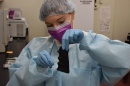
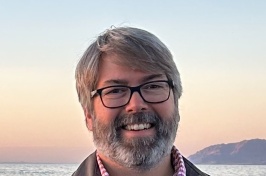
Professor Lucy Salyer at The National Archives in Kew, England
Professor Lucy Salyer, department of history, received one of the 2007-08
CIE Faculty International Travel grants funded by the VPAA, and traveled
this summer to England and Ireland where she presented a paper at the
Anglo-American Conference of Historians held in London, and conducted
research at the National Archives of the United Kingdom located in Kew,
and at the National Archives of Ireland in Dublin
As an American historian, my research usually takes me to rather mundane
places – the National Archives in Washington, D.C., the Massachusetts
Historical Society, the California State Library in Sacramento, to name
a few. This summer, I was fortunate to expand my scholarly horizons as
I traveled to London and Dublin for three weeks, with the assistance
of a grant from the Center for International Education, to participate
in a conference and conduct research in various archives.
While it may not have been the best time to visit those cities, with
their record-breaking rainfall and the plummeting value of the dollar,
the trip proved very beneficial in developing scholarly contacts and
gathering material for my book project.
I am currently writing a book, tentatively entitled “Pledging
Allegiance,” on the history of American citizenship law since the
Civil War. The book begins with a major issue in citizenship law after
the Civil War: the right to give up one’s citizenship and pledge
allegiance to a new sovereign. It tells the story of Irish American nationalists,
the “Fenians,” who launched attacks on Canada and traveled
to Ireland to foment rebellion against British rule in the 1860s.
While their objective was Ireland’s independence, the Fenians
sparked an international crisis over the boundaries of national citizenship
as the Irish Americans were arrested and tried for treason as British
subjects. The British government refused to recognize their American
citizenship, obtained through naturalization, insisting that anyone born
within Britain (including all of Ireland at the time) remained a British
subject for life. Some Fenians were sentenced to death while others were
ordered to serve long prison terms at hard labor. The Fenian trials provoked
an uproar of protest in the United States and led to the passage of the
Expatriation Act of 1868 and the negotiation of Naturalization Treaties
with several European countries which explicitly recognized the right
of individuals to immigrate and become citizens of new lands.
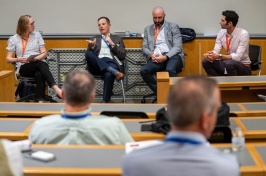
I had the opportunity to present a paper on my research in London at
the annual meeting of the Anglo-American Conference of Historians, sponsored
by the Institute of Historical Research at the University of London.
The conference draws scholars from the United Kingdom, the United States,
Canada, and Europe with an interest in British history.
This year’s theme for the conference–“Identities:
National, Regional and Personal”–fit well with my own interest
in the shifting boundaries of national allegiance. I met several scholars
studying immigration and citizenship and received very helpful feedback
from Irish historians who have a deep interest and knowledge of the Fenian
movement of the 1860s. I hope it is only the beginning of an international
scholarly exchange.
Kilmainham Gaol, the prison in which the Fenian prisoners
were held in Dublin, Ireland
Most of the time, however, I spent in the archives, trying to gather
as much material as I could in a short time. I spent two weeks at the
National Archives of the United Kingdom, located in Kew, England, and
one week at the National Archives of Ireland and the National Library
of Ireland in Dublin.
After going through the usual period of adjustment – getting to
know the staff, understanding the unique rules of each archive, trying
to decipher the handwriting and acronyms used by bureaucrats and officials
from 150 years ago–, I found I had a treasure trove of material.
I read correspondence from the highest level officials in the foreign
offices of each country, police reports from the sergeants on the Dublin
Police force, letters from the Fenian prisoners to officials and to their
friends and families, and official registers documenting the arrest and
treatment of each prisoner.
I was able to view photographs and physical descriptions of many of
the leading Irish American Fenians; the British government in Ireland
used photographs as a mean of identifying and tracking prisoners for
the first time when it arrested hundreds of suspected Fenians in 1865-1866,
leaving future historians a rich visual record of the Fenians. All of
these documents allowed me to gain a variety of perspectives, seeing
the issue from the position of the national policy makers as well as
from those most directly involved at the local level.
My research was not limited to the archives. Perhaps the most enjoyable
part of my trip was exploring the Fenians’ history on foot through
the city of Dublin, finding the now abandoned courthouse where they were
tried, the houses they took refuge in, and the prisons in which they
were incarcerated.
The Kilmainham Gaol, now a museum, has housed many of Ireland’s
political prisoners, including the Fenians, over the past two centuries.
A tour of that prison and the cells from which the prisoners wrote their
appeals provided me with a much better sense of their physical and social
context. (As a side benefit, it also provided wonderful examples on the
historical developments of prisons and criminal justice which I will
draw on in my legal history courses.) It also led to one of the most
fruitful discussions I had in Dublin; a casual question to the man operating
the museum’s bookstore led to an hour-long conversation as he turned
out to be very knowledgeable about the Fenians’ history in Ireland.
I returned with more than enough material to complete the section of
the book on the Fenians and the issue of expatriation. The trip also
provided the groundwork for another possible book, focused solely on
the Fenians. So, as they would say in Dublin, “thanks a million!” to
the CIE for helping to make the trip possible.