


































Equal Access Trail Opens In College Woods
By Beth Potier, Media Relations
October 24, 2007
College Woods -- the university’s most-used woodland property and
a resource for research, recreation and instruction -- is now easier to
access than ever, thanks to the completion of a mile-long equal access
trail. Three years in the making, the equal access trail follows federal
guidelines to allow access to a range of users, including those who use
wheelchairs and other assistive devices.
“The guiding principle in this project is based upon our desire
to make available the widest range of non-invasive recreational opportunities
on University Woodland properties,” says Stephen Eisenhaure, land
use coordinator in the UNH Office of Woodlands, who led the project. He
credits Sarah Smith, forest industry specialist with UNH Cooperative Extension,
for the idea of enhancing the woods’ accessibility.
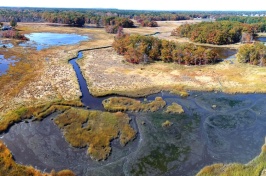
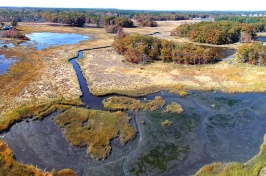
The trail, a gently graded path that stretches nearly a mile to a scenic
overlook of the Oyster River, is already one of the most popular in College
Woods. Working with student technicians from the Thompson School of Applied
Science, Eisenhaure improved much of the trail surface with crushed stone
that, in some cases, buried obstacles like large rocks or roots. Areas
once muddy after storms now stay dry, thanks to culverts that divert water
beneath the trail into the wetlands that surround it. Three benches, of
native red cedar harvested from College Woods and milled at the UNH Sawmill,
provide resting places at the top of steeper grades.
Eisenhaure notes that the goal of the project was not to “pave paradise”;
rather, it aimed to make subtle changes to the woodland path that open
it to the widest range of people. That wide range goes beyond wheelchair-users
or those who identify themselves as having a disability: “Somebody
who can’t walk very far or very fast can now enjoy College Woods,” he
says, and anyone can appreciate not slogging across a muddy section of
trail. “It really is for everybody.”
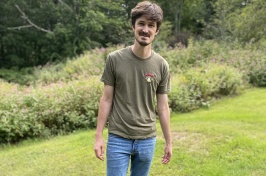
Stephen Eisenhaure, land use coordinator in the UNH Office of Woodlands
Total cost of the three-year project was $15,000. Funding for the equal
access trail was contributed by the U.S. Forest Service, the UNH Parents
Association, Campus Recreation, and the university’s Space Allocation,
Repair and Renovation Committee (SARRC). In addition, the Office of Woodlands
and Natural Areas contributed funds generated through timber sales on UNH
woodland properties.
The equal access trail is part of a larger effort to increase recreational
use of College Woods and UNH’s other woodland properties. Major trail
entrances to the university’s most heavily used recreational properties – including
College Woods, East and West Foss Farm, Thompson Farm and MacDonald Lot
in Durham and Kingman Farm in Madbury – are now marked with large
trail maps and informational signs. These trail maps, with much greater
detail and clarity than previous ones, will soon be available to download
at the Office of Woodlands Web site: http://www.unh.edu/woodlands/.
“We want to open the woods to those who may not have used them before,” Eisenhaure
says. “They really are for everybody.”
The equal access trail starts at the main entrance to College Woods on
Colovos Road, behind the Field House. From Main St. in Durham, turn onto
College Road (at the lights). Turn right onto South Drive and continue
under the new Southern Underpass. Take an immediate right onto Waterworks
Road, which becomes Colovos Road. Parking is available at the trailhead.
For more information on College Woods, go to http://www.unh.edu/woodlands/properties/colwoods/index.html.