















Sen. Judd Gregg Celebrates Nation's First Commercial Offshore Mussel Farm
By Beth Potier, Media Relations
October 17, 2007
All photos by Perry Smith
U.S. Senator Judd Gregg (R-NH) joined UNH faculty and students
in Portsmouth to celebrate the nation’s first commercial
offshore mussel farm. The farm, operated by New Hampshire fishermen
Andy Lang and Robert Bryant, uses technology and know-how developed
by scientists at the university’s Atlantic Marine Aquaculture
Center. The farm’s blue mussels — “Isles
of Shoals Supremes” — have just hit local markets
and restaurants.
“Open-ocean farming of mussels is an environmentally
sustainable practice and an economically viable option for
New Hampshire fishermen, and best of all they taste great,” said
Gregg as he sampled the new product at a dockside event at
Portsmouth’s Fish Pier. “Supporting our commercial
fishing industry requires innovative strategies, the kind that
come from combining federal and state support with the research
talent at University of New Hampshire and the entrepreneurial
spirit of Northeast fishermen.”
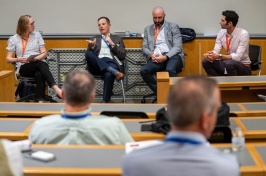
In addition to Gregg, speakers included Lang, owner of A.E.
Lang Fisheries; Richard Langan, director, UNH Atlantic Marine
Aquaculture Center; and Taylor Eighmy, UNH interim vice president
for research. Guests toured the Meriel B. (the UNH aquaculture
research vessel) and the Eastern Star, (the fishing vessel
that has been outfitted to tend the new farm), sampled fresh
Isles of Shoals Supremes mussels, and learned more about university’s
offshore fish and shellfish research.
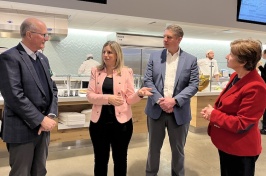
Taylor Eighmy, interim vice president of research at UNH,
presented Gregg with a custom apron for cooking mussels
Funding for the research that led to the mussel farm was secured
by Gregg and is administered by the UNH Atlantic Marine Aquaculture
Center, formerly known as the Open Ocean Aquaculture Project.
The grant is provided through the National Oceanic and Atmospheric
Administration.
The center’s goal is to conduct research and technology
development necessary to stimulate a sustainable offshore aquaculture
industry in New England and nationwide. The center developed
the technology to farm and harvest blue mussels in a submerged,
open-ocean environment, and worked with commercial fisherman
Lang to establish a mussel farm in2005. Lang is now working
with Bryant to manage the farm.
Ralph Coughenour, director of culinary services for UNH Dining,
prepared fresh Isles of Shoals Supreme mussels for the event.
Lang’s farm is located off the coast of Hampton, out
of sight and safely beneath boat traffic. From the surface,
only two pairs of buoys, bobbing about 600 feet apart, are
visible. The farm is rigged with longlines, each spanning 600
feet and anchored to the seafloor at each end by a two-ton
granite block. Two clusters of submersible floats raise the
line to form the corners of a backbone from which loops of
mussel grow-out ropes are suspended.
Richard Langan, director of UNH’s Atlantic Marine Aquaculture
Center, gives Gregg a tour of the Meriel B., AMAC’s research boat
“We need alternatives in the face of changing fishing
restrictions and the fact that our fisheries are not an infinite
resource,” said Lang. “Mussels are a clean fishery,
and this is straightforward technology. The scientific support
from UNH has been wonderful, the quality of the product is
superior — I think we can raise the finest mussels in
the world in right here in New Hampshire.”
At its current size of 12 longlines, this farm can produce
up to 180,000 pounds of mussels annually. Because the mussels
are raised in a less turbulent environment than those farmed
near shore, they have thinner shells and larger meats, making
for a superior-tasting mussel. In addition, because mussels
feed on naturally occurring microscopic plants free of additives,
they are environmentally sound and sustainable.
“Andy and Bob’s success in taking our technology
out of the laboratory and into the marketplace is enormously
satisfying to see,” said AMAC director Richard Langan. “We
look forward to realizing similar success with our open-ocean
finfish aquaculture work.”