Adventures in Writing
By Shannon O’Neill
October 3, 2007
Two dollars: that’s all students in Jayson Seaman’s Theory
of Adventure Education (KIN 681) class had when they traveled to Boston
and had to figure out how to travel, eat, and lodge without money; all
the while attempting to complete a scavenger hunt. Students ate leftovers
from restaurant kitchens and slept in hospital waiting rooms. One lucky
group managed to persuade hotel staff to let them spend the night for free.
The ultimate goal of the trip? To write about it.
In fact, writing was an integral part of the adventure: through it students
discovered how their experiences connected with or “fell outside
the scope of the theories” they have studied.
During their excursion, students in this writing intensive (WI) course
kept journals in which they recorded their observations. Students then
used their journal notes as data for analysis and as an aid to write a
larger paper.
In this longer piece, students analyzed one of the field’s foundational
models, for example, the Outward Bound Process Model, by comparing it to
their data while also being critical of the theory, raising questions about
it and showing Seaman that they understand it. This model “prescribes
a set of conditions under which a small group of people might learn by
solving challenging and novel problems together,” Seaman said.
This is just one of the three major papers required of students in this
course. Other writing assignments include 10 reading responses and two “experience
sampling journals,” one for each of the class’s two labs. During
the labs – one of which was the Boston trip – students jotted
down their observations and reflections every two hours.
Writing intensive courses are meant to provide “writerly” experiences
for students in a wide array of courses, some of which aren’t generally
associated with writing. In WI classes, the curriculum is enhanced by treating
writing as a process, including both formal and informal writing, and having
writing account for more than 50 percent of the course grade.
Seaman, who also equipped his students with emergency money, a list of
emergency phone numbers, and the duty of checking in with him while he
and they were in Boston, said students in his class, “use writing
as a tool to help understand the content and to develop ways of analyzing
the texts they are reading—including the ‘text’ of their
own experience.” The purpose of the reading responses is to help
students feel prepared for discussion by “engaging in the author’s
intent,” summarizing the article, and rehearsing their own arguments
in preparation for the papers.
Students in KIN 681 typically pursue careers in three different areas:
wilderness therapy, public and private education, and nonprofit outdoor
center management. Writing, in Seaman’s opinion, should not be just
for English majors.
“I want writing to further my students’ interests in the field,” he
said. “I see writing as a way to help them develop dexterity with
the field’s foundational ideas. Later, they may need to write proposals
to schools or other organizations in which they work, and good writing
is very important to administrators and supervisors.
“The ability to write in different genres is also a kind of cultural
capital,” he continued. “There is some expectation of college
graduates that they could be involved in writing as a mode of argumentation.
This class helps with that.”
The importance of writing in Seaman’s class is further demonstrated
by the fact that writing assignments are a whopping 70 percent of students’ final
course grades. But his kinesiology students aren’t simply tossed
into the writing life – he and English major Amanda Howe, a junior
and the course’s writing fellow, engage the students in writing workshops.
Writing fellows, the undergraduate equivalent of graduate teaching assistants
or TA’s, are specially prepared students and veterans of the course
who are chosen by the professor. They also must be strong writers as they
help provide students with guidance on how to write effectively for the
class.
The student and the writing fellow have frequent writing conferences during
all stages of the writing process. The workshops, unlike those in English
classes, are not peer editing sessions but discussions dedicated to the
strategies of writing and to the difficulties students have faced while
writing their papers.
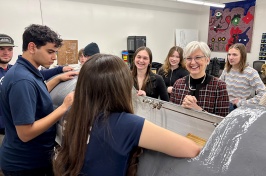
A typical workshop might include Howe and Caitlin Hayes, an assistant
director for the Writing Center, offering practical writing advice that
would be useful even to English majors. They focus on revision techniques,
such as making a backwards outline to reassess the organization of a paper,
and writing multiple drafts and urged students to, as Hayes said, “spread
your energy out; don’t put it all in one draft and save it until
the last minute.”
Howe has them write an informal letter to her, to Seaman, or to themselves,
which serves as a reaction to Seaman’s and her comments on their
papers and as a recognition of what they need to work on - almost a proposal
for what they plan to change in their revisions.
Howe’s interaction with students is ongoing, as she has conferences
with them periodically. She describes the conferences as engaging and says
that both she and the students have learned from one another because of
them.
“Having a lively discussion about writing is far more productive
than simply lecturing the students,” she said. “I love feeling
as though the student has opened my eyes to topics I have never thought
about and writing styles I haven’t come in contact with, and at the
same time the student takes my criticism, or doesn’t, and explains
why, and I can see his or her improvement.”
Seaman can also see their improvement; because of Howe and the numerous
writing assignments, he says there has been a “noticeable difference
in quality of writing.”
Andreas John, a senior kinesiology major with an outdoor education concentration,
certainly feels that way. John sees writing as not only “a joy,” but
also an essential skill that will benefit him in the future. He hopes to
one day start an educative retreat center that focuses on sustainability,
alternative health, mindfulness, and yoga.
“To me, writing well is one of the most essential skills a college
graduate can have,” he said. “I plan to use my skills as a
writer as much as possible after graduation. It has helped me immensely
in my education as well as in pursuing a career.”
Although Seaman’s enthusiasm for writing seems to be contagious
in the classroom, he emphasizes that his course is a work in progress.
This is his first year teaching it alone, – he co-taught it four
years ago while getting his PhD in Education – and he is still experimenting
with the course and its assignments.
“I hope they see it as a way to improve their writing,” he
said, “and I hope the focus on process in this class makes them feel
supported.”