Keeping our Water Clean
By Erika Mantz, Media Relations
March 21, 2007
Even though we have seen some frigid, snowy weather during the past few
months, it is officially spring. The vernal equinox, which signifies the
first day of spring, was Tuesday, March 20. The change in season indicates
warmer temperatures are on the way, snow will be melting and those New
Hampshire rainstorms are just around the corner. So, what does this have
to do with keeping our water clean?
“Everything,” says David Gillum, assistant director of the
UNH Office of Environmental Health and Safety. “The public drinking
water for the campus and Town of Durham comes from the Oyster and Lamprey
rivers. These rivers are fed by precipitation throughout the year.”
Here at UNH, snowmelt and rainfall enters into the campus storm water
sewer system through a series of pipes, catch basins, and other devices
that are separate from the sanitary sewer system, and is released into
the Oyster River and eventually the Great Bay. With this runoff goes oil,
debris, cigarette butts, pet waste, sand and salt, and other pollutants.
There is no treatment of the storm water runoff.
In March 2003, the U.S. Environmental Protection Agency identified
storm water pollution as a significant problem and required all areas
identified in the 2000 U.S. census as “urbanized areas” to
develop a program to manage storm water runoff. Since UNH falls into
a region that is considered an urbanized area the campus had to apply
for a National Pollutant Discharge Elimination System (NPDES) permit
and develop and implement a written Storm Water Management Program. This
document is available online at http://www.unh.edu/ehs/stormwater/.
The University is also required to submit a report each year documenting
actions taken to comply with the U.S. EPA’s regulations.
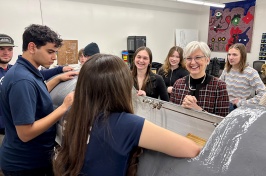
During the past year, student employees in the Office of Environmental
Health and Safety have applied new, “No Dumping – Drains to
Bay” placards on campus catch basins. When this wasn’t an option
because of recurrent theft of the placards, they made stencils out of old
cardboard boxes and spray painted the marking on the asphalt. “The
students were very ingenious,” says Gillum. “They found a cost-effective
solution to a significant problem.”
“
I am really happy the University is taking steps to protect
our water supply,” says Matt Polzin, a graduate student in the Liberal
Studies program. Matt has been working on the storm water management program
for two years. Matt regularly attends the New Hampshire Seacoast Storm
Water Coalition meetings for UNH. “We have a great program here and
we’re way ahead of many other places.”
To report storm water violations, please call the Facilities Support Center
at 862-1437. For questions about the UNH Storm Water Management Program
should be sent to david.gillum@unh.edu.