Taking Risks: "Geek" Goes For It on Reality Show
By Jody Record, Campus Journal Editor
March 21, 2007
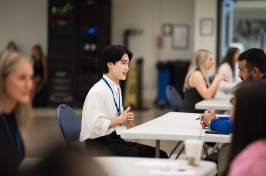
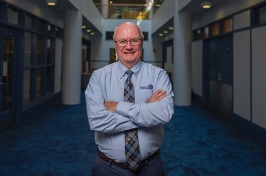
Nate Dern, left, and assistant professor Brent Bell answer
questions during Bell’s “Risk and The Human
Experience” class.
So, it really is all in the eye of the beholder.
Just ask Nate Dern, the Harvard student and TV reality
show contestant who appeared in this season’s “Beauty
and the Geek” on the CW.
Dern was on campus last week where he spoke in assistant
professor Brent Bell’s class “Risk and The
Human Experience.” The two had met previously when
Bell led an outdoor program at Harvard; Dern was a student
leader.
Bell’s students had been discussing the types of
risks people take--physically, cognitively or socially,
for example, with stepping out of one’s comfort zone
socially perhaps being the greatest risk of all. There
was also a lot of talk about categorization and its impact
on perception. That is, as Bell put it, “if you think
something is, your brain locks on and tries to reinforce
it.”
“Beauty and the Geek” matches up eight beautiful
women with eight geeky guys who then undertake a series
of challenges that test them in areas outside their comfort
zone: the beauties have to find books in a library using
the Dewey Decimal system, for example, while the geeks
try to get women to give them their phone numbers.
Dern’s take on the show—where the winning
couple stood to take home $250,000-- was that, initially,
it did just that. All of the guys—culled from such
known brainiac schools as Harvard and MIT—took one
look at the models and aspiring actress they would be paired
with and thought “beauty.”
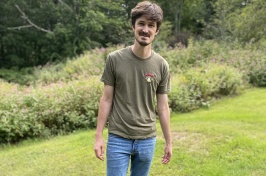
And the girls—well, here’s what Dern looked
like before his television makeover: he had a big bushy
beard and wild matching hair; his normal “uniform’ was
all things plaid. Mismatched plaid, mind you. And he donned
one of those spongy high-brimmed long-distance trucker
ball caps. He and the other guys reaffirmed the girls’ perception
of geeks without even opening their mouths.
Funny thing was, Dern never considered himself one.
“I’m more of a dork,” he said. “Going
into the show, I hadn’t ever classified myself as
a geek. I thought of myself as different and I liked being
different.”
Being on the television show, whose aim was to make people
not only step outside their comfort zone but re-think their
perceptions of the two labels--gave him the chance to reflect
on those kinds of invisible categories, he said. One of
his conclusions? Some people take refuge in stereotypes
because it allows them to stay within their comfort zones.
And because it was, after all, television, there was a
bit of enhancement done to support the beauty or geek persona.
Two months of filming were somewhat selectively edited
down into eight episodes that left viewers thinking the
guys were, as Dern said, all critical thinkers and the
girls were all materialistic.
“There was some jockeying with the guys for who
was the geekiest—the smartest. And there was pressure
on the girls, too,” he said.
No one was instructed to act a certain way but when he
was recruited—picked out for his appearance while
walking around Harvard one day—he was told it would
be “cool if I didn’t shave my beard.”
Before “Beauty and the Geek,” Dern assumed
everyone-- regardless of how they appeared--thought the
way he did, believing life was about helping people. He
thought that even if someone seemed superficial, deep down,
they valued the same things.
“After the show, I thought maybe people do value
different things,” Dern said. “Heading into
the show, I had no idea a purse could cost $5,000. Or that
someone would spend that much money on one.”
A reality TV show pushes the social risk boundaries, Dern
said, because it means “putting yourself out there
and being judged by other people.”
“The task and the challenges were secondary,” he
said. “For me and for some of the other guys, it
made us question our own identity and what’s important.
One way I’ve described the show is, it was kind of
like getting the wind knocked out of me and I’m still
trying to catch my breath.”