




























Why Wildcat? The Facts Behind the Cat
By Jody Record, Campus Journal Editor
March 7, 2007
1935: First wildcat image used for athletic event programs. Artist unknown.
Choosing a mascot was not a task taken lightly by students attending the
university in 1926. They thought long and hard about just what kind of
image they wanted associated with their sports teams. Discussions went
back and forth in The New Hampshire for several weeks.
Some people were behind ‘the Huskies’ while others felt ‘the
Eagles’ presented a more powerful image. The local paper had already
dubbed the hockey team the “Durham Bulls.” But a vote taken
on February 4 of that year settled it once and for all: UNH teams would
be known as the Wildcats.
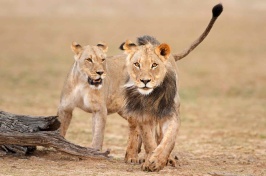
Not long after, an actual wildcat made its debut at the 1927 homecoming
game. It seems a group of students learned that a farmer in Meredith had
snared a wildcat. The honor society The Blue Key took up a collection and
bought the cat.
The students named her Maizie and brought her, in a cage, of
course, to all of the home games. After the football season ended she
was given to Benson’s Animal Farm in Hudson. When she died in 1929,
members of the honor society had her stuffed. Maizie is now in the university
archives.
Several other wildcats followed Maizie. Bozo was bought from Benson’s
in 1932. Students decided to rename him after the first football player
to score a touchdown during the next home game. Bozo soon became Skippy
after Robert “Skippy” Haphey (’35). But his tenure at
UNH was short-lived; Skippy disappeared in the spring of 1933.
The scoring incentive was going to be used to name the next cat but, as
fate would have it, the first score of the games turned out to be a field
goal. Some students thought he should still be named for that player—Henry—while
others thought it should be for Charles, who scored the first touchdown.
Middle ground was reached by going with Butch, after head coach William “Butch” Cowell
and every mascot to follow also bore his name.
In 1939, a week before a big football game against Harvard, Butch II was
kidnapped. Tufts had just lost to UNH so, along with the Crimson, were
suspected of taking him from his cage, kept behind the Lambda Chi Alpha
fraternity house. Students scoured Boston and Cambridge for Butch II but
there was no sign of him. Then, after he’d been gone for three days,
an insurance salesman from Woburn, Mass., found the wildcat in his garage. “Harvard-60,
N.H.-0” was written on top of the box he was in but Harvard students
swore they had nothing to do with Butch II’s disappearance.
Butch III, purchased in 1940, died a week after he arrived in Durham.
Members of the Blue Key were persuaded to give up the idea of having a
live mascot, perhaps prompted by a n unidentified student who wrote, “The
well-intentioned persistence of Blue Key in attempting to keep a mascot
not susceptible to domestication seems to many of us, in view of the net
results, very unwise."
Thirty years later, a Somersworth man named Jackson Chick was in Texas
making a film about wildcats when he came across a six-week old kitten.
Fudge—so named by Chick’s granddaughter--was raised by his
family, who had him de-clawed. He became tame and Chick offered him up
as mascot for football games. But Fudge only lasted one season, being bothered,
as the other cats had been, by the noise of the crowds.