


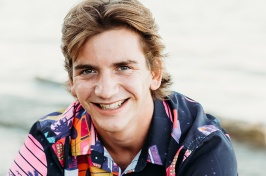
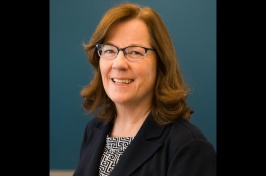
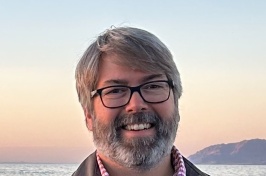

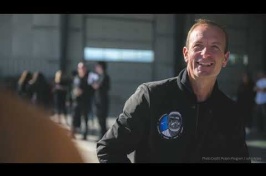

Roland Goodbody - Manuscripts Curator and Library Associate, Milne Special Collections, UNH Library
June 6, 2007
Photo by Christina VanHorn, Human Resources
Roland Goodbody would be the first to admit that his job is not everyone's
cup of tea.
"Most people like to live in the present," he says. "I
spend my working life living with the past," then adds jokingly, "I
guess it helps if you have a high tolerance for working with ghosts."
As manuscripts curator in the Milne Special Collections department of
the UNH Library, Goodbody works with the paper remnants of other people's
lives, sometimes laboring for years to prepare them for public use. During
the last 21 years he has sorted, arranged, described and preserved a large
and varied assortment of manuscript collections for potential use by researchers.
The collections vary in size from a few folders to the largest, the papers
of Donald Hall, the current Poet Laureate of the United States, which run
to approximately 450-500 cubic feet and are still being processed after
more than 20 years work (Hall continues to produce a prodigious amount
of material each year). "You have to take the long view," Goodbody
says. "To do it right, the work can't be hurried."
The collections - groups of materials whose contents vary according to
the occupation or activity of the collector, but which usually include
correspondence and manuscripts - come from individuals, families, organizations,
or institutions and are bequeathed to the library for their potential value
as primary source material for historians and researchers. Often, however,
the papers arrive at the library in a perplexing jumble of boxes and cartons
and in a haphazard arrangement.
"In some ways my job as an archivist is very like that of a custodian.
On the one hand, I'm trying to tidy up and clear a path through the confusion
so that the materials can be used by others. On the other, I need to handle
those materials with care, removing staples, repairing the worst of the
paper tears, placing them in acid-free folders within acid-free boxes,
and clearly labeling them so that they will be available for future generations."
But he says he also feels like a detective at times.
"I work with what is left on the scene after the main action has
occurred, trying to reconstruct a picture of what went on, sifting the
evidence for clues and looking for connections that might shed light on
the order and scheme of things, so that I can better present the contents
to future researchers. I spend a lot of time trying to decipher what is
in front of me, coddling the information, gently coaxing the subject back
to life."
The analogy to a detective first occurred to him last summer, Goodbody
says, when he spent three months working on a collection of Arthur Conan
Doyle/Sherlock Holmes papers at the City Museum in Portsmouth, England,
an opportunity he created for himself.
"I read about the collection in the New Yorker and thought, here's
a chance to widen my horizons. So I contacted the museum and offered my
services. They jumped at the offer."
The collection, bequeathed by the late Richard Lancelyn Green, the world's
foremost authority on Conan Doyle, was a classic example of the disarray
he mentions and called for some informed guesswork, or as he began to think
of it, sleuthing.
"I grew up in England," says Goodbody, "and lived in Portsmouth
for a year right after high school. What I only found out much later was
that my flat was one block away on the one side from where Peter Sellers
was born and the same distance on the other from where Arthur Conan Doyle
had his first medical practice and where he wrote the first Sherlock Holmes
story. So, I had lived smack bang in between the birthplaces of two of
the world's most celebrated detectives, that model of deductive reasoning,
Sherlock Holmes, on the one hand, and on the other, Inspector Clouseau,
the sublime example of police ineptness. It was as if I was destined to
be a detective myself, albeit in a different guise. That's when I started
to wonder which one I would most resemble."
Given his active imagination, it comes as little surprise to learn that
outside of the UNH community, Goodbody has been involved in the Seacoast
theatre scene for 25 years, acting, writing and directing, primarily with
Generic Theater. In 2005, he received a nomination for Best Actor at the
Spotlight awards for his performance as Johnny PateenMike in Irish writer
Martin McDonough's "The Cripple of Inishmaan."
In 2004, he performed two of his own pieces, "Giving The Game Away" and "Woman
On A Train" in a one-man show called "Goodbody Goodbody in a
Pair of his Own Shorts." He will be appearing this summer at the Hackmatack
Playhouse in Berwick in compatriot Alan Ayckbourn's comedy “Communicating
Doors”.
Since May of 1988, Goodbody has also hosted a weekly radio show on WUNH-FM,
the student radio station here on campus. Airing on Sundays from noon to
2 p.m., the show is called Ceili and features music in the traditions of
the Celtic countries and England. He maintains a website (www.ceili.unh.edu)
that includes updated calendar listings for live concerts and playlists.
Goodbody received a BA in English and American Studies from the University
of Keele in the English Midlands and came to this country for the first
time in 1973 on an exchange program with the University of Massachusetts
in Amherst.
"It was a great year and really opened my eyes, so I decided to come
back and do my graduate work over here," Goodbody said.
He worked on a master's degree in English at UNH and has been here ever
since. His family still lives in Hampshire, England, and he spends every
summer vacation there. "My mother lives in a lovely village - called
Rowlands Castle, strangely enough - that's bordered by a forest where I
happily go running for hours. I still think of England as home, as where
I really belong, despite having lived here for more than thirty years."
When asked what he finds most satisfying about his job, Goodbody answers, "To
see collections that I have spent hundreds of hours, and perhaps years,
organizing and describing being used by researchers - and then sometimes
cited in papers and publications, proving that the material was both useful
and usable. I enjoy organizing historical materials and getting them into
the hands of those who need to use them."