































Biodiesel Group and Conway Company Team Up in Research Project
By Matthew Gianino, Institute on Disability / UCED
June 6, 2007
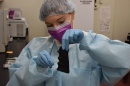
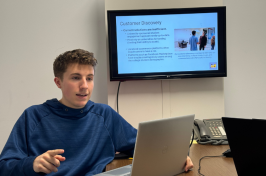
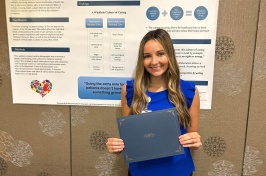
Kristopher Cui, left, winner of a Student Award of Excellence, stands
at his poster with his adviser, professor. Ihab Farag, at the Undergraduate
Research Conference.
Say you’re a freshman at UNH. One day you eat lunch in the dining
hall and have some fries with your burger. A week later, you hop on Wildcat
Transit to catch a ride to your dorm. The fuel for that shuttle bus might
have been made from the same canola oil that bubbled in the deep-fry cooker
the week before.
The Biodiesel Group in the chemical engineering department, led by professor
Ihab Farag, has drawn up plans for an automated processor to turn waste
vegetable oil into biodiesel fuel that could be used in university vehicles
and other diesel-powered engines, or anywhere that heating fuel is used
on campus.
Hardware and process control designs are completed and testing has begun.
Next year, students will add automation equipment to the manual processor
at the Woodman Farm on campus and produce biodiesel.
UNH will save money because it will not have to pay a waste collector
to haul away the spent cooking oil, and it will have to buy less biodiesel
for its vehicles. However, the greater benefit may well belong to the university’s
industry partner in this project, MBP, Bioenergy, LLC of Conway.
MBP’s original patent-pending design, the Weevo processor, is a
small manually operated unit with a range of commercial applications, depending
on the amount of waste vegetable oil produced annually, the availability
of labor and a use for the finished product, biodiesel. Company president
Jim Proulx knew it would capture a much larger market if it could be automated.
He turned to Farag and UNH for the engineering and computer expertise to
take his product to the next level. In less than a year of tinkering and
trial-and-error, they found that automation was indeed feasible.
The company’s Weevo processor is the only “micro machine” on
the market at a price that yields a reasonable return on investment and
is capable of converting waste vegetable oils or equivalent feedstock oils
into biofuel that meets the industry standard for quality, says Proulx.
Automation will reduce labor, increase production and allow for remote
monitoring, all of which are significant advantages for small-scale producers.
With proof-of-concept in hand, and a projection of the potential market,
they called the New Hampshire Industrial Research Center for some help.
A grant of $40,000 covered the research expenses at the university, and
it was matched by contributions from MBP. One year later, the project is
nearly complete and Proulx is impressed with the efforts of the students
and the results.
“Our work with Dr. Farag’s team at UNH will help us to expand
our product base, increase our market opportunities, and empower our firm
to meet the increasingly challenging demands of biodiesel producers worldwide,” says
Proulx. MBP projections call for placing 20 processors in each state within
the first year of commercial production, with a processing goal of 5 to
30 million gallons.
Two chemical engineering students who worked on the MBP project are residents
of Barrington and graduates of Dover High School. Joseph Pearson has worked
on the project for two years and, as a senior in the fall, will see it
to fruition at the Woodman Farm.
Kristopher Cui, who graduated with honors in May, has been hired by OSRAM
Sylvania. Cui won an Award of Excellence for his presentation at the vice
president for research symposium at the Undergraduate Research Conference.
He was one of 20 students to receive the honor.
“Research opportunities for undergraduates at UNH can open doors
for graduate education or employment,” says John Aber, vice president
for research. “We are fortunate to have such dedicated faculty to
guide our student research projects.”
The goal of the New Hampshire Industrial Research Center is to create
industry-university research partnerships that result in jobs and economic
development. The NHIRC issues a request for proposals twice a year for
its Granite State Technology Innovation Grant. For more information, go
to www.nhirc.unh.edu.