




















At Home in the World: Excellence in Teaching
By Carrie Sherman, The College Letter, liberal arts newsletter
February 28, 2007
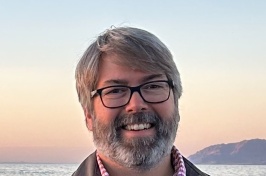
Photo: Lisa Nugent
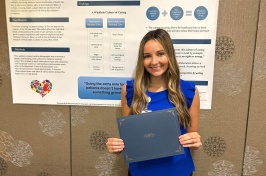
Even though Jennifer Stynes had studied Spanish since eighth grade, she
didn't like to speak it. Then, as a sophomore, Stynes enrolled in John
Chaston's class.
“I took two classes from Professor Chaston that year,” she
recalls. “He was the one who made me want to declare Spanish as my
major.”
As a Spanish major, Stynes was required to study abroad, and she was hesitant.
She has trouble explaining why that was the case. At first she simply says, “I
don't like change. It was a push for me to go to UNH even though I'm from
Boston.” Then she adds, “I was scared because I wasn't confident
enough in my ability to speak Spanish.”
Chaston encouraged Stynes to go. He had her listen to tapes of Spanish
speakers. The father of five children and a soccer coach, Chaston, the
'06 director of the Granada program, found more ways to be supportive. “He
showed me pictures of Spain. When he had cookouts for students at his house,
his whole family encouraged us–they're awesome,” says Stynes,
who did indeed go to Spain this past semester.
Chaston is a master at moving students beyond Stage 2 to Stage 3, which
is considered pivotal. Stage 3 is about real language and real conversation.
“Have you seen the snow–cone diagram of language learning?” asks
Chaston. He opens a wire–bound book, The New Hampshire Guidelines
for World Language Learning K–12, to which he contributed. (New Hampshire
schools now teach both French and Spanish about equally.) “These
first two stages go by the introductory grammar books,” he says,
pointing to the very tip of the cone graphic. “But after that in
Stage 3 and beyond, the grammar rules as they are presented don't always
work and students discover that the vocabulary in those texts is far too
limited.”
As a sociolinguist, Chaston speaks with an authority that few possess.
A graduate of the renowned Spanish linguistics program at the University
of Texas at Austin, Chaston has listened to and analyzed the speech of
hundreds of native speakers. He has written academic papers on, for example,
the use of the subjunctive and indicative or the preterit and imperfect.
In his undergraduate phonetics course, Chaston teaches the three skill
sets that students need to master in order to acquire Stage 3 proficiency–theory,
speaking (practice), and understanding (listening). He doesn't make it
easy, but he does make it fun.
For example, after extensive study and preparation, he'll have students
listen to and transcribe portions of interviews he has recorded with native
speakers from all Spanish–speaking countries. The oral histories
they've listened to include the story of an exiled Cuban's rescue at sea;
a Puerto Rican fable of how the owl got his feathers; and a discussion
of why Colombian farmers are so willing to grow the coca plant for cocaine
production. Students learn about Spanish cultures and also become comfortable
with a variety of dialects.
A technological innovator, Chaston creates CDs, which record fun cultural
vignettes that evolve into lessons on syntax. The result is the listener
learns (painlessly): “Oh, so that's how they'd say, 'These fireworks
are amazing!'”
As Chaston notes, students learn because they want to communicate. Ever
the coach and social scientist, Chaston also tests students frequently
to make certain they're getting it. If a student is slipping, Chaston,
whose office door is always open, makes sure that student gets help.
“As a teacher, I always think–'some other parent wants me
to do for their child what I want them to do for mine,'” says Chaston.
Indeed, in Granada this past spring, students told Chaston that he came
to Spain with two kids and left with 40 more.
As for Stynes? She's certain she wants her career to incorporate Spanish,
perhaps living abroad. Her confidence is inspiring. She is now someone
who feels at home in the world.