Mining Expert Hamilton Smith II Shared His Wealth
By Jody Record, Campus Journal Editor
February 21, 2007
Hamilton Smith
If not for the death of his mother in 1845, Hamilton Smith II may never have
found his way to Durham even though family ties went back for generations.
Smith, as it’s easy to surmise, is the man behind the naming of Hamilton
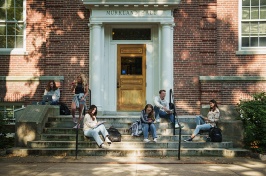
Smith, the building that houses the English department. Smith Hall was named
for his wife, Alice Jennings Congreve Smith.
In the mid-1600s, Quaker Joseph Smith bought a parcel of land along the Oyster
River. His great-great-great grandson, Valentine Smith and the grandfather of Hamilton
Smith II, was born here two years before America won its independence from
the British.
Hamilton Smith I was born during Valentine Smith’s first marriage. (His
second was to Betsy Ballard of Ballard Hall.) Another son, Joshua, lived in
Durham in the Valentine Smith House, until he was 101.
Hamilton Smith spent very little of his life in New Hampshire until his retirement.
A lawyer, he was partners with Salmon P. Chase, secretary-treasurer of the
United States under Lincoln, and later a Supreme Court justice. The senior
Smith also had an interest in a cotton factory. He became involved in the development
of coal mines in Indiana and founded the town of Cannelton there.
Smith married a woman from Kentucky, where Hamilton Smith II was born in Louisville
on July 5, 1840. It was Martha Hall’s death five years later that resulted
in Smith being sent to Durham to live with his grandfather, Valentine.
In 1854, after graduating from Durham Academy, the younger Smith moved to
Cannelton and worked in the engineering and accounting departments of his father’s
company, the Cannelton Coal Mines. A move to southern California in 1870 to
manage the Triumfo mines led to his distinction as the authority on hydraulic
mining in the state. His book “Hydraulic” is in the Dimond Library.
A mining expert, Smith also became interested in high explosives and founded
the Vulcan Powder Works. Opposition from farmers over debris from hydraulic
mining led to injunctions. Smith moved to New York and then, in 1881, became
a consultant for a mine in Venezuela owned by the Rothschild family.
Five years later, Smith formed a partnership with a Mr. de Crano and they
founded the Exploration Co. Limited of London. It was there that he married
the widow Alice Congreve.
From London, Smith traveled to South Africa where he helped found two companies,
the Consolidated Deep Levels and the Transvaal and General Association Limited.
Smith was also involved in the London stock market where he introduced such
mine securities as the Alaska Treadwell, the Alaska United and the Alaska Mexican
Gold Mining Companies.
The Smiths returned to New York in 1886. Three years later, Smith retired
to Durham and on December 2, 1890, he bought the house known as the Red Tower—later
student housing--which he built into a 70-acre estate. He also bought a lot
across the street (where St. George Church is now located) and built a house.
At some point, the house was moved to Ballard Street and then later, became
the rear of what is now Schofield House.
Smith Hall
With no children of his own, (his step-daughter was Edith Angela Congreve,
who was known for her extreme generosity to the university and the town of
Durham) Smith became very attached to his dogs. He even had a little cemetery
in his backyard.
On July 4, 1900—the day before his 60th birthday—Smith was in a boat on Little Bay with his sister and two of his dogs, Hannah and Joy. The boat ran aground at what is now Sandy Point. In attempting to free the launch, he suffered a heart attack and died.
In his will, Smith left the university $10,000 to use to help build a library.
A $10,000 bequeath made when he was alive created the Valentine scholarship,
the first UNH scholarship for non-resident students. The $16,000 gift in his
memory from his wife helped fund Smith Hall, the university’s first dormitory.
And money from his estate—about $120,000—was used to build the
first part of Congreve Hall.
On June 3, 1907, the Hamilton Smith Library was dedicated. It was used until
what is now the Dimond Library was built in 1958.