

































It's Elemental: Excellence in Teaching
By Robert Emro
February 21, 2007
© Lisa Nugent
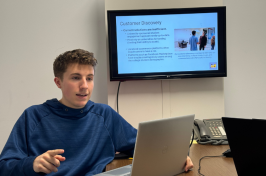
When lecturing a large class on the subject of polymer chemistry, Richard
Johnson occasionally pulls “the spider joke.” It starts with
a casual remark about a spider on the floor behind the lectern. A little
later, he’ll mention that it’s really quite big. Then he’ll
bend down and pick up a gigantic jiggling arachnid, launching the students
out of their seats. One word brings them back to the subject at hand: “plastics.”
During more than 20 years at UNH, Johnson has learned an important lesson. “It’s
OK for students to think you’re a little eccentric,” he says. “If
you’re not having fun in the classroom, you’re students aren’t
having fun.”
“Fun” and organic chemistry don’t go together in most
students’ minds; “fear” is more often the case. Besides
the complexity of “orgo,” students have the added pressure
of knowing medical and graduate schools may view their grade in this single
course as an important barometer of their overall academic ability. “I
really have to build confidence in the students,” says Johnson. “This
is not just another course, but something that needs to be integral to
their education because organic chemistry is everywhere.”
Knowledge of organic chemistry is built like a brick building, layer upon
layer. A poor grade on the first exam indicates a weak foundation, so Johnson
tells struggling students to look at the answer key and then see him for
help. A successful early intervention can save the semester. “The
best compliment is when a student walks in and says she was afraid at first,
but ended up really liking the course,” he says.
One way Johnson makes his classes more interesting is by using examples
from his own research, which touches on everything from strained molecules
and atmospheric chemistry to polymers and carbohydrate mass spectrometry. “Textbooks
are too dogmatic. They give students the impression that everything is
known,” he explains. “In fact, the frontiers of chemistry are
just beyond the textbook.”
Johnson’s specialty is using computers to expand those frontiers.
The common theme to his eclectic research interests is applying computer
molecular modeling to questions of chemical behavior. How do carbohydrates
fall apart in a mass spectrometer? How much strain can you pack into a
molecule? “A lot of the chemistry we do is pure science,” he
says. But, don’t take that to mean it’s boring. He adds, “Organic
chemistry is the chemistry of life.”
As one classroom example, Johnson uses a new molecule he discovered with
a graduate student. Called 1,2,3-cyclohexatriene, it’s short-lived
because of an unusual or “strained” geometry. He draws a diagram. “If
a student were to write this on an exam, most instructors would mark it
wrong,” he says, “but our goal is to make molecules like this.”
Students are also surprised by the grad student’s name. “I
can claim to be a senior coauthor to William Shakespeare, which no one
in the English department can do,” says Johnson with a chuckle.
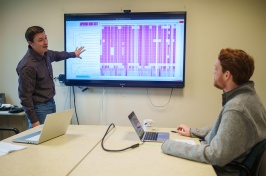
Johnson has found that molecular modeling also works well in the classroom.
His course Web site includes numerous models for students to download.
Working as a consultant, he helped Wavefunction, a leading chemistry software
company, design a student version. During the last 10 years, he has presented
more than 50 teacher workshops or lectures on molecular modeling at schools
nationwide—from high schools to Harvard.
While he embraces technology as a teaching tool, Johnson says nothing
beats the pace and structure of a chalkboard lecture for teaching a subject
like organic chemistry. “The classes I enjoy the most are the big
classes. You get a lot of bang for your buck,” he says. “There’s
nothing like walking out at the end of the day and knowing you’ve
really given a good lecture. When it all works—that is a great feeling.”