Dispatches from Budapest
By David Hiley, Justice Studies Budapest program supervisor and professor of philosophy
February 7, 2007
© David Hiley
The headline on CNN International read “Budapest Burning.” On
September 20th, the television screen filled with images of
protesters burning cars and breaking into the Hungarian television
station on Szabadsagter–Freedom Square–where the
U.S. Embassy is also located.
I opened my e-mail to find messages from family, friends,
and parents of students: Were we in danger? Were buildings
near us burning? Should we make plans to leave Budapest?
Looking out of my window toward Freedom Square and the Parliament,
there was no
evidence of Budapest burning. But news of the protests continued.
Serious developments, regardless of CNN hyperbole.
We had been in Budapest a little over a month—my wife
and I, plus 12 UNH students. We knew that an incriminating
tape recording of a private speech by Prime Minister Ferenc
Gyurcsany to his party members had been leaked to the press.
In it he admitted they had “lied morning, noon, and night” about
the condition of the economy during the last election. Because
of Hungary’s soaring deficit, it cannot adopt the EURO,
the next step in its ascension to the European Union. Hungarians’ growing
awareness of the country’s dire financial condition,
coupled with their reaction to the proposed austerity measures,
had created an incendiary situation. The leaked tape ignited
more than a week of protests and calls for the prime minister’s
resignation.
Our immediate concern, and the concern of the staff in the
college, was the safety of our students, some living in flats
near Freedom Square. As the week unfolded, while the size of
the protests grew, the violence abated. Gyurcsany remained
steadfast in his refusal to resign. By the end of the second
week, the Parliament grounds took on an almost festive air.
Tour buses slowed enough for their patrons to snap pictures.
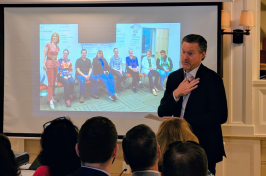
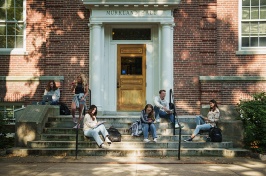
© David Hiley, Students in the Justice Studies Program study at Corvinus University of Budapest, Hungary. The program is in its fourth year.
From tourist to student
For the Justice Studies Program, this began our transition
from tourists to students. As part of the program, students
take courses in Hungarian history, culture, and politics from
Hungarian faculty. I teach a course on democracy and global
justice, complemented by weekly field trips focused on the
Hungarian justice systems. The protests provided an unexpected
learning opportunity. Our students began to explore the causes
of the protests in a larger context.
Hungarian history is tragically complex. Freedom and democracy
are recent experiences here. Hungarians have been dominated
by a series of occupying forces beginning in 896 and ending
in 1989. Numerous revolutions have failed. This year marks
the 50th anniversary of the failed 1956 Revolution, which began
on October 23rd. For 12 days, Hungarians rose up against the
Soviets who had occupied the country since 1945.
This anniversary has offered another unplanned part of our
educational program. We have attended a documentary film festival
and conference of participants and eyewitnesses to the Revolution.
We are learning that Hungarians are still uneasy with this
revolution. While the 12 days of freedom produced a euphoric
sense of solidarity, it also included well-publicized atrocities.
Participants and historians disagree about some of the events,
the meaning of the Revolution, and the period that followed.
For our students, this has been an exceptional lesson in the
politics of history.
© David Hiley
Budapest is a beautiful city. At night, lights tracing the
design of the famous Chain Bridge are reflected in the Danube
River. But in the light of day, graffiti covers every surface
below 10 feet. Try as they might, city workers cannot get ahead
of the litter. Homeless people sleep in doorways and underpasses.
A few sparkling blocks gleam for the tourists, but the city
continues to show the decades of Soviet neglect.
Our students struggle with the contradictions. Last week I
met with each student. All talked about seeing beyond the postcard
pictures. They think more seriously about the life of a city
and a country so newly free and a people less privileged than
themselves. For me as a teacher, this time in Budapest has
provided a classroom for raising issues about the nature of
freedom, democratization, and how much harder it is to be free
and democratic than simply declaring it so.
Professor Hiley’s most recent book, “Doubt and
the Demands of Democratic Citizenship” examines democracy
and the responsibilities of citizenship in the U.S.
< go back