













Student Researchers to Present Findings at Science and Engineering Symposium
By David Sims, Institute for the Study of Earth, Oceans, and Space
April 25, 2007
On Wednesday, April 25 from 2 to 5 p.m., more than 180 UNH undergraduate
students will present results of their research on a broad spectrum
of projects in science and engineering.
The fourth annual Interdisciplinary Science and Engineering Symposium
(ISE), hosted by the Institute for the Study of Earth, Oceans, and Space
(EOS), is part of the university's eighth annual Undergraduate Research
Conference (URC), which runs April 23- 28. ISE offers a unique opportunity
to visit the world of cutting-edge research at UNH, to discover interdisciplinary
connections between issues, and learn about research opportunities for
students.
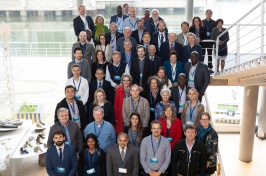
This year’s ISE symposium will be the largest yet and will include
10 undergraduate researchers/presenters from Elizabeth City State University
in North Carolina – a historically black university that has partnered
with UNH on projects in an effort to recruit students from minority
populations into the scientific and technical workforce of the future.
“Our goal this year was to not only increase the number of participating
students but also to include faculty from a broad range of science and
engineering departments so we can increase the visibility and energize
the whole program,” says EOS research assistant professor Ruth
Varner, chair of this year’s ISE event.
Students from all corners of UNH work with faculty mentors to conduct
scholarly inquiry into topics that intrigue them and engage in a process
that teaches creative thinking and problem solving within their chosen
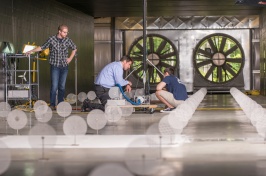
disciplines. At the ISE, student presentations will run the gamut from
robots and microbial fuel cells to projects building instruments for
NASA satellites and studies of turbulence of the solar wind.
Varner notes that the URC-ISE poster sessions provide a unique opportunity
for students to summarize their research and present it to their peers
as well as a non-scientific audience. “When you have to present
your research on a poster or in a talk it requires that you have thought
through the process, you have to have a really good handle on the background
of your science question,” Varner says.
Some 73 project posters involving 180 students from 20 departments
and four colleges will be presented at the event. A panel of 10 experts
will judge poster presentations and six $500 awards will be given to
students for excellence.
The New Hampshire Space Grant Consortium, headquartered at EOS, funds
one of the awards for best poster and has provided travel funds for
students, such as those from Elizabeth City State University, to participate.
Space Grant also supports students who were awarded UNH Undergraduate
Research Opportunity Program fellowships and end up presenting results
of their research at URC and ISE.
Says David Bartlett, director of Space Grant and associate director
of EOS, “Space Grant's interest is to stimulate more, and more
diverse, students to enter science, math, and engineering as a career,
and so the philosophy of the URC is certainly consistent with that.” Bartlett
adds, “Undertaking research at an early stage creates excitement
and incentive for students to continue pursuing their studies in these
fields, and also better prepares them for the future by introducing
them to the ‘real’ activities of scientists and engineers.”
Indeed, former ISE presenter and award winner Claire Treat would second
Bartlett’s assertion.
Treat, who graduated from Mount Holyoke College, did undergraduate
research at EOS after winning an internship from the joint UNH-NASA
Research & Discover program (http://www.eos.sr.unh.edu/ResearchAndDiscover)
in the summer of 2003. This led to a two-year R&D graduate fellowship
and an independent research project, with Varner as her advisor, studying
aspects of natural methane emissions in peatland – research she
ultimately was invited to present at an ISE poster session.
Now a research assistant and lab manager at Michigan State University
studying the impacts of climatic change on the carbon balance of Alaskan
peatlands, Treat says of her ISE experience, “During my poster
presentation, I received some helpful feedback from people regarding
other things that I might want to consider, and it was also helpful
to see what other students were doing in terms of research projects.”
She adds, “For me, it was also a proud moment to represent undergraduate
women in science research, as I was the only woman selected for the
award.” Treat went on to present her research to the Ecological
Society of America and at American Geophysical Union meetings, and published
her findings in the Journal of Geophysical Research –Biogeosciences
this past February.
The ISE is an opportunity for students to present their research projects
in a professional forum and for all attendees to gain information on
the related research activities and opportunities at UNH. Attendees
will include UNH faculty, staff, students, university leaders, and members
of the public. In addition to student presentations, several UNH research
and graduate programs will present information to prospective students.
For the full schedule for this year's Undergraduate Research Conference,
including the ISE, directions, and parking information, visit http://www.unh.edu/urc.
A video clip of last year’s event is also available at the site.
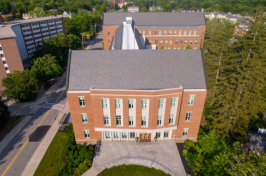
The ISE event will be held in Morse Hall at 39 College Road. The public
is welcome. Refreshments will be served.